
The tip of a white head cut through a sky layered in shades of gray like fish scales. A beak thrust forward followed by the ivory tuft of tail feathers. Talons dangled, slicing the air.
The grip on my paddle slackened and the current snagged my kayak, completing the turn around the river bend without assistance. The bald eagle, its wings seeming to spread across the width of the river, burst from a pine. Brittle needles drifted to the water.
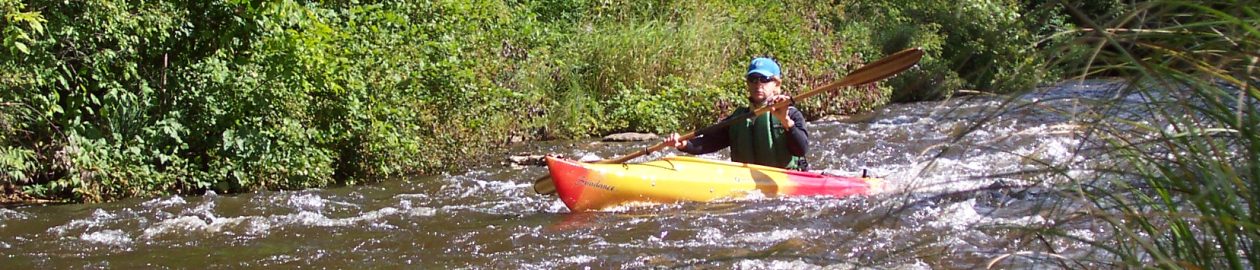
The eagle arced toward my husband Keith and me, our kayaks splashes of red and blue in the swirling river. A flash of dark wing and creamy head and then the bird banked, soaring away, disappearing with the river as it wrenched out of sight. The moment passed; the rapids grabbed my boat and it twisted, pointing in the wrong direction, forcing me to act. I grasped my paddle and followed the eagle, swept away by nature, by the force of the Pigeon River.

Slipping in and out of the Pigeon River Country State Forest, home to the largest wild elk herd east of the Mississippi, the Pigeon River is both sassy and placid, with no livery service and numerous snags and rapids. It winds through undeveloped woods and past log cabins, ending at Mullet Lake, about 42 miles from its headwaters northeast of Gaylord.
The river’s namesake forest boasts 105,000 acres spread across Otsego, Cheboygan and Montmorency counties. It retains an isolated feel with few paved roads, rugged trails, overlooks spanning uninterrupted treescapes, and the constant possibility of seeing elk. Reintroduced in 1918, the elk now number in the 800s and official elk-viewing areas dot the forest.
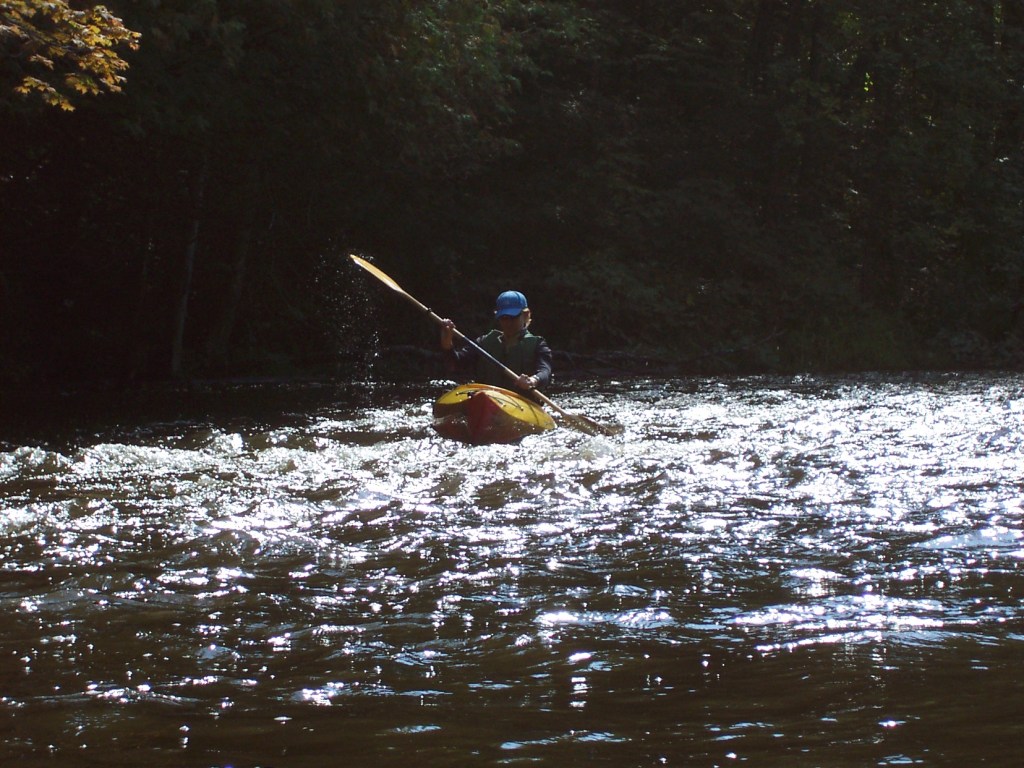
Hoping to spot watering elk, we tackled a portion of the Pigeon River. Earlier that day, before encountering the eagle, a thumping sound had poured from a cluster of trees, their scraggly branches wrapping around each other, as if arm-in-arm. The noise filled me, a rhythm that seemed to join with the beating of my heart, and then it separated, became distinct. The thump, thump, thump of a ruffed grouse flapping its wings, performing its mating ritual, continued as I clambered into my kayak and pushed off the river bank, its muddy sides leaving streaks, like war paint, on my boat.
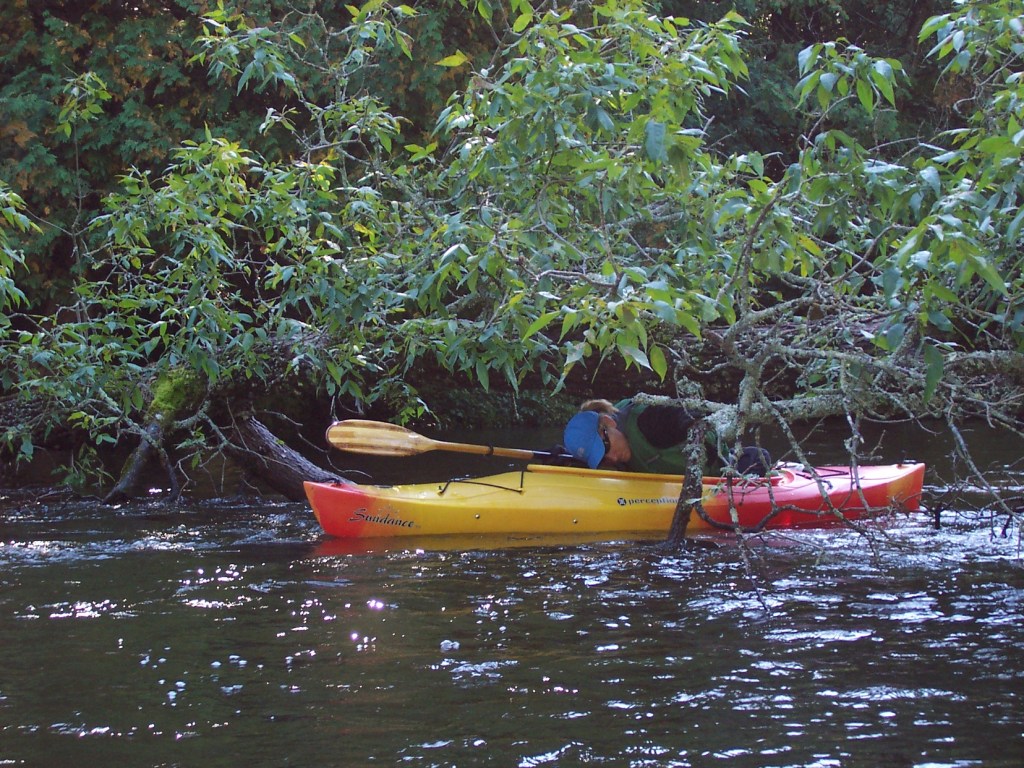
The current pulled me underneath a bridge and a drilling woodpecker replaced the drumming of the grouse. Then all was silent, even the riverside cabins emitted an air of abandonment. Trees reached across the river with branches like bony fingers. A pine, almost completely lying in the water, clung to the bank and grew at an angle, ready to collapse, hovering between life and death. Two ducks erupted from beneath it, swimming with energy, their alarm at seeing us almost palpable.

Farther along, we startled a boy fishing next to the river. Wind tousled his brown hair and he splashed through the shallows in waders. He said something, pointed, but the river swallowed his words. I leaned forward, trying to capture his meaning, and almost ran sideways through a chute created by two downed trees.
A beaver dam blocked a tributary to the right and it splashed over the edges, swamping the forest, beating with rushing fists at the dam. It cascaded into the river with impatience, loudly announcing its arrival. Another partially-completed beaver dam threatened to block the river. We slipped by it but not before we heard the splash of a beaver’s tail.
Soon we passed the upended roots of an old tree sitting in the middle of the river. Weathered, sculpted by water, the roots had become a wooden web, a honeycomb of niches, as artistic as a commissioned sculpture.
The river, swollen from recent rain, tugged us ahead. Water splashed inside our kayaks as we navigated around boulders. Miscalculating, I rode my kayak on top of a rock. I perched there for a second, my fate in the river’s watery fingers, teetering between a tumble into cold water and a rush through speeding waves. The river sympathized and my boat slid off the rock and slipped through the ripples. A few more bends in the river brought us to the M-68 bridge, where our truck waited.
But Pigeon River Country wasn’t finished with us yet. We returned to the heart of the forest later in the year, trying again for a glimpse of the elusive elk. We swapped kayaks for bikes and pedaled along the two-mile Pickerel Lake Pathway. Brush scratched our legs and we bounced over downed trees, their branches scattered across the trail.
At Pickerel Creek, where a wooden bridge spanned the water, we left the pathway, following a faint trail to the right that became clearer as we scrambled up a hill. A boy, swinging a water bottle, stood at the top in an unimproved parking area. Startled to see us, he stared, as the rest of his party walked toward him. He continued watching us, as if specters had suddenly emerged from the woods, and we disappeared down a singletrack, digging into its sandy surface, vanishing into Green Timbers.

Adopted by the forest in 1982, this 6,300-acre non-motorized area has a varied history from fishing resort to logging to livestock grazing. Today, although its past is still apparent in places, Green Timbers is a delicious escape, with old doubletracks, white pines shooting to the sky, and waterways hosting brook and rainbow trout.
Bouncing down a doubletrack, we arrived at Green Timbers Cabin, a log shelter dominated by meadow, towering pines, and the gurgling Sturgeon River. Inside, old smoke lingered and a pentagram, crudely carved into a rear wall, made the whispered retelling of ghost stories easy to imagine.
Climbing back onto our bikes, we cycled up a sandy trail. Huffing, we arrived at the Honeymoon Cabin, perched on a hill overlooking Green Timbers. A path led past a gazebo with an outdoor fireplace and onto the cabin’s wrap-around porch. We rested there, the perfect picnic spot, and the stillness and vistas soaked in, making conversation unnecessary.
Retracing the trail back to Green Timbers Cabin, we explored more doubletracks, crossing over Pickerel Creek on a wooden bridge, where trees crowded and a blue jay darted in front of us. We worked our way to paved Sturgeon Valley Road and followed it until we reached the trailhead for Shingle Mill Pathway.
The 11-mile loop, part of the 80-mile High Country Pathway (a rugged trail that rolls through every imaginable terrain), dipped and climbed across hills, always hovering near the Pigeon River. Sweeping through history, it ran past Cornwall Flats, the site of an early 1900s lumber mill, and next to the forest’s log visitors center/headquarters, 13 miles east of Vanderbilt.
We reached Grass Lake Overlook after about 61/2 miles. Framed by trees, it offered slices of sky and not a single manmade structure. Tree bouquets clustered together like a florist’s arrangement; yellow and burgundy leaves flamed with the sun. I was breathless, thirsty, and hungry but I couldn’t have been happier. The elk had remained hidden but the forest had captured me nonetheless. And I was swept away. Swept away by Pigeon River Country.
Traveler’s Notes:
Visitors to Pigeon River Country State Forest should be prepared for a rugged experience. Trail maps and other information are available at the Pigeon River Country Headquarters (9966 Twin Lakes Rd., Vanderbilt, MI, 49795, 989-983-4101) or from the Pigeon River Country Association (PO Box 122, Gaylord, MI 49734, http://www.otsego.org/prca/). A detailed description of paddling the Pigeon River can be found in Canoeing Michigan Rivers by Jerry Dennis and Craig Date.
This article was first published in Whisper in the Woods.
 N. Michigan River Paddling